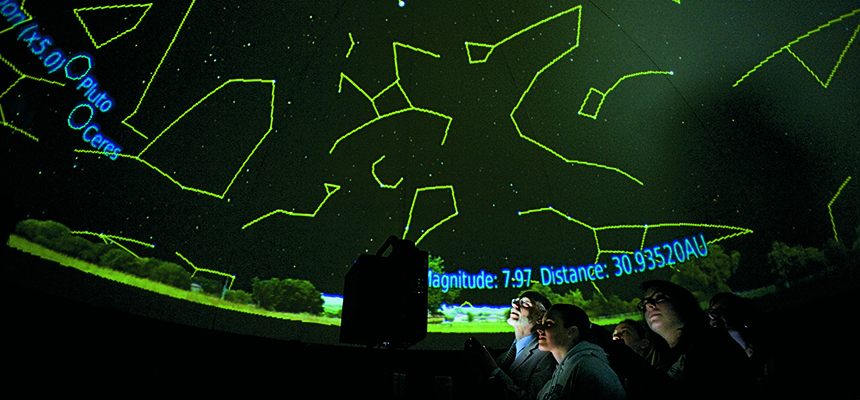
The bachelor's degree in Physics at NDMU explores events and interactions that occur in nature in order to understand the laws that govern the physical world. Core courses introduce concepts of mechanics, thermodynamics, special relativity, quantum mechanics, and cosmology. Our physics majors are challenged to be active learners—lab courses, original research projects, and internships develop professional skills that prepare for graduate school in advanced fields of science and engineering.
Research
One of the hallmarks of the rich educational environment at NDMU is the opportunity to participate in research in your field of interest. Our annual Nancy Kreiter Student Research Day provides the perfect forum to showcase your hard work with a formal research presentation to the NDMU community.
Capstone Experience
In the third or fourth year, physics majors take everything learned and apply it through a teaching assistantship, research assistantship, or internship. The capstone experience integrates theory, science, and practice. It is an opportunity to explore your area of interest and apply classroom learning to a real-world experience.
Examples of Capstone Experiences
- International Research in England and China through NANOGrav
- National Student Leadership Conference, Engineering Program Team Advisor
- Summer Research in Nuclear Physics at University of Indiana-Bloomington
- UMD GRAD-MAP Summer Research Program at University of Maryland-College Park
- Research Collaboration with NDMU Faculty
Physics Careers
Understanding the principles of physics can lead to a wide range of careers including opportunities in renewable energy, climate and weather, technology, and space.
Graduates of the NDMU physics program have secured positions at organizations such as:
- NASA/Goddard Space Flight Center
- NASA/Marshall Space Flight Center
- U.S. Department of Energy
- Lockheed Martin
- Peace Corps
- Johns Hopkins Applied Physics Lab
Graduate Programs
- Physics
- Applied Physics
NDMU graduates have also gone on to pursue graduate programs in a variety of fields including applied optics, electrical engineering, and nuclear fusion.
Additional Info
| Fall | Spring | ||
|---|---|---|---|
First Year |
|||
| NDMU 100 | 2 | PHY 102 | 4 |
| PHY 101 | 4 | MAT 212 | 4 |
| MAT 211 | 4 | MAT 243 | 3 |
| ENG 101 | 3 | RST 105 | 3 |
| COM 106 | 3 | NDMU 100 | 2 |
| [16 credits] | [16 credits] | ||
Second Year |
|||
| PHY 201 | 3 | PHY 316 | 3 |
| MAT 213 | 4 | CST 171 | 3 |
| PHY Elective | 3 | PHL 201 | 3 |
| Lang 1 | 3 | Lang 2 | 3 |
| PED | 1 | Elective | 3 |
| [16 credits] | [14 credits] | ||
Third Year |
|||
| PHY 314 | 3 | PHY Electives | 3 |
| CHM 110 | 4 | CHM 111 | 4 |
| GE | 3 | MAT 315 | 3 |
| GE | 3 | GE | 3 |
| Elective | 3 | Elective | 3 |
| [16 credits] | [16 credits] | ||
Fourth Year |
|||
| PHY 315 | 3 | PHY 463 | 1 |
| GE | 3 | PHY Elective | 3 |
| GE | 3 | GE | 3 |
| Electives | 3 | Electives | 3 |
| Electives | 3 | Electives | 3 |
| [15 credits] | [13 credits] | ||
Notes:
# offered alternative years
+ need to take at least two physics courses at level 300 or higher
*Courses with a designation of “L” are taught at Loyola. Notre Dame students take the courses through the cooperative program. For more information, contact the program chair
MAT 211 – Calculus I (4)
MAT 212 – Calculus II (4)
PHY 101 – General Physics I (4)
PHY 102 – General Physics II (4)
PHY 201 – Modern Physics (3)
One other course in mathematics, physics or computer science at the 200-level or higher (3)
Total Credits = 22