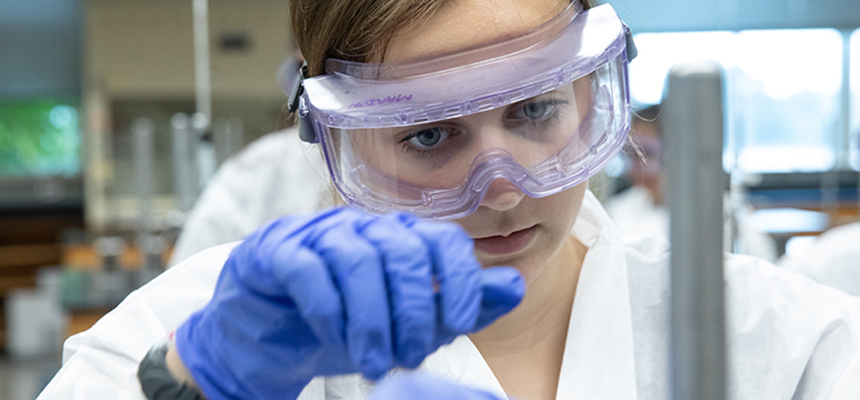
The bachelor’s degree in Chemistry at NDMU provides both a broad view and a deep understanding of the chemical sciences. Starting with a foundation of chemical principals, lab techniques and best practices, the program builds to advanced topics including chemical identification, data interpretation, and experiment design. Our chemistry majors are encouraged to go beyond classroom learning and explore interests through original research, internships, and creative experimentation with faculty support. Graduates are prepared to pursue careers in research, pharmaceutical sciences, biotechnology, medicine, and more.
Research & Networking
As a chemistry major, you are encouraged to pursue internships, contribute to professional conferences and symposia, attend meetings of the Maryland Section of the American Chemical Society (held on campus and locally), and take part in chemistry department seminars and other events.
Examples of Research Opportunities
- Army Medical Research Institute of Chemical Defense
- University of Maryland School of Pharmacy Department of Pharmaceutical Sciences
- Research Experiences for Undergraduates (REU) sponsored by the National Science Foundation
One of the hallmarks of the rich educational environment at NDMU is the opportunity to participate in research in your field of interest. Our annual Nancy Kreiter Student Research Day provides the perfect forum to showcase your hard work with a formal research presentation to the NDMU community. Chemistry majors also present work at local and national meetings featuring undergraduate research.
Top students are eligible to join the Sr. Alma Science Year fellowship that engages them in hands-on research with scientists at Johns Hopkins School of Medicine.
Chemistry Careers
A degree in chemistry can lead to a wide variety of careers in research, pharmaceutical sciences, biotechnology, medicine, engineering, or education.
Examples of chemistry careers include:
- Applied Research & Product Development
- Quality Control
- Environmental Protection
- Forensic Chemistry
- Chemical Engineering
- Technical Sales and Marketing
For more information about careers in chemistry, visit the American Chemical Society.
Graduate Programs
Many graduates of the Chemistry program go on to pursue graduate or professional programs, including:
- Medicine
- Pharmacy
- Dentistry
- Veterinary Medicine
- Engineering
- Education
Additional Info
Below is a sample Program of Study for the Chemistry Major.
Students should select courses with the assistance of a faculty advisor.
See Course Descriptions for a list of required courses and description of course and program options.
|
Fall |
Spring |
||
|---|---|---|---|
|
First Year |
|||
|
NDMU-100 Perspectives in Education |
4 |
ENG-101 College Writing |
3 |
|
BIO-111 Fundamentals of Biology |
4 |
RST-105 Religion and the Big Question |
3 |
|
CHM-110 General Chemistry |
4 |
CHM-111 General Chemistry II |
4 |
|
MAT-211 Calculus I |
4 |
MAT-212 Calculus II |
4 |
|
[16 credits] |
|
[14 credits] |
|
|
Second Year |
|||
|
CHM-210 Organic Chemistry |
4 |
CHM-211 Organic Chemistry II |
4 |
|
PHY-101 Physics I |
4 |
PHY-102 Physics II |
4 |
|
COM-106 Fundamentals of Oral Communication |
3 |
Religious Studies (300/400) |
3 |
|
History |
3 |
Philosophy (200) |
3 |
|
Foreign Language |
3 |
Physical Education |
1 |
|
[17 credits] |
|
[15 credits] |
|
|
Third Year |
|||
|
CHM-301 Physical Chemistry I |
4 |
CHM-302 Physical Chemistry II |
4 |
|
CHM-350 Chemical Literature |
1 |
CHM-401/408/325/426 Advanced Topics/Research/Biochemistry I II |
4 |
|
CHM-407/425 Research/Biochemistry I |
4 |
Literature |
3 |
|
Philosophy (300/400) |
3 |
Fine Arts |
3 |
|
General Education/Electives |
6 |
General Education/Electives |
3 |
|
[18 credits] |
|
[17 credits] |
|
|
Fourth Year |
|||
|
CHM-303 Analytical Chemistry |
4 |
CHM-305 Instrumental Analysis |
4 |
|
MAT-213/315/PHY-201or CST-295 |
3 |
CHM-450 Chemistry Seminar |
2 |
|
Social Science |
3 |
Electives/Internship |
9 |
|
General Education/Electives |
6 |
[15 credits] |
|
|
[16 credits] |
|||
If you are interested in pursuing a professional program after graduation, NDMU offers specialized advising to help you prepare.
Types of Professional Programs
- Health Professions (Medical, Dental, Veterinary & More)
- Law School
- Pharmacy School
- Veterinary School
Pre-professional coordinators can help you:
- Choose a profession that aligns with your interests and goals
- Select a bachelor’s degree program that will meet required prerequisites to apply to a professional school
- Monitor your academic progress through in-depth, one-on-one advising sessions
- Explore experiential learning opportunities and secure internships
- Connect with alumni who currently work in the field
- Prepare for the application process