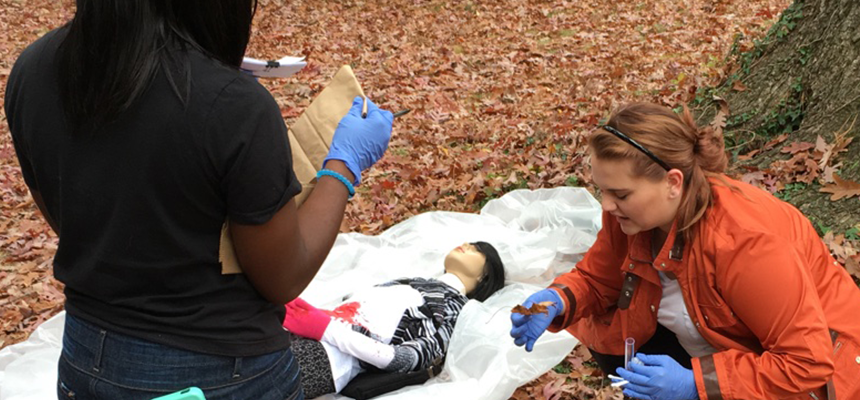
The bachelor's degree in Criminology and social deviance at NDMU draws on the theories and science of criminology and sociology to analyze criminal behavior with a focus on social justice. The program takes a holistic approach to understanding the cause of criminal behavior by examining the evolution of criminological theory as well as societal factors at the micro and macro levels. It also explores the complex dynamics of the criminal justice system with an emphasis on how race, class, culture, and gender impact criminal justice and social systems. Our criminology and social deviance majors develop professional skills that prepare for careers in law, corrections, victim advocacy, and child welfare.
Criminology and social deviance Minors
At NDMU, our strength is our ability to weave your unique interests into your individual education. Adding a minor to your degree is a great way to craft an experience that aligns to your aspirations.
The Minor in Criminology and social deviance provides a basic understanding of criminal behavior and the criminal justice system today. It prepares for careers that include policymaking, community action, social research, criminal justice careers, federal service careers, and social services.
Majors that often add a criminology and social deviance minor include Political Science, Chemistry, Computer Information Systems, and Psychology.
Sociology
The Minor in Sociology examines the inner workings of social institutions, patterns of social relationships, and the collective behavior of organized groups to better understand society and the roles we play. Courses explore social issues including crime, education, poverty, immigration, institutional discrimination, and prejudice.
Sociology is a versatile minor that could be applied to any number of majors. Popular majors that often add a sociology minor include Art, Business, Education, Communication Arts, Criminology and social deviance, Philosophy, Religious Studies, Psychology, and Political Science.
Research
One of the hallmarks of the rich educational environment at NDMU is the opportunity to participate in research in your field of interest. Our annual Nancy Kreiter Student Research Day provides the perfect forum to showcase your hard work with a formal research presentation to the NDMU community.
Practicum Experience
Criminology and social deviance majors complete a supervised field experience in their fourth year. More than an internship, the practicum experience integrates theory, science, and practice.
Practicum placements are selected based on learning objectives to prepare you for graduate school or entry level employment.
Examples of Field Placements
- National Security Agency
- Baltimore State’s Attorney’s Office
- House of Ruth
- Sheppard Pratt
- Family League of Baltimore
- Bureau of Alcohol, Tobacco, Firearms and Explosives
- Maryland State Police
- Department of Juvenile Services
- Baltimore Office of the Public Defender
- Baltimore Child Abuse Center
Criminology and Social Deviance Careers
The Criminology and social deviance major prepares graduates to pursue a wide variety of career paths in law enforcement, social work, law, victim services, child welfare, corrections, investigations, social services.
Employment Opportunities
- Nonprofit Agencies – Social Worker, Policy Advocate, Research Analyst
- State & Federal Courts – Victim Advocate, Lawyer, Judiciary Clerk, Court Bailiff
- Corrections Departments – Correctional, Probation, or Parole Officer
- Law Enforcement Agencies – State or Local Police, Sheriff’s Deputy, School Resource Officer, Detective
- Juvenile Justice Agencies – Caseworker, Juvenile Probation, Parole or Corrections Officer
Additional Info
Sample program of study for full-time Criminology and social deviance majors. Students should consult with the program coordinator for their academic plans as many courses are offered on alternating years.
| Fall | Spring | ||
|---|---|---|---|
First Year |
|||
| ENG 101 College Writing | 4 | SOC-101 Introduction to Sociology | 3 |
| CRM-101 Introduction to Criminology and social deviance | 3 | ||
| NDMU-100 Perspectives in Education | 4 | General Education/Electives | 9 |
| General Education/Electives | 6 | [15 credits] | |
| [16 credits] | |||
Second Year |
|||
| CRM-203 Theories of Crime | 3 | CRM-360 Research Methods | 4 |
| SOC-209 Race, Class, Gender | 3 | Criminology and social deviance Elective | 3 |
| General Education/Electives | 9 | ||
| General Education/Electives | 6 | [16 credits] | |
| [15 credits] | |||
Third Year |
|||
| Criminology and social deviance electives | 6 | Criminology and social deviance electives | 6 |
| General Education/Electives | 9 | General Education/Electives | 9 |
| [15 credits] | [15 credits] | ||
Fourth Year |
|||
| CRM-461 Practicum | 4 | Departmental Senior Elective | 3 |
| General Education/Electives | 6 | General Education/Electives | 9 |
| Criminology and social deviance elective | 3 | [12 credits] | |
| [13 credits] | |||
If you are interested in pursuing a professional program after graduation, NDMU offers specialized advising to help you prepare.
Types of Professional Programs
- Business
- Law School
Pre-professional coordinators can help you:
- Choose a profession that aligns with your interests and goals
- Select a bachelor’s degree program that will meet required prerequisites to apply to a professional school
- Monitor your academic progress through in-depth, one-on-one advising sessions
- Explore experiential learning opportunities and secure internships
- Connect with alumni who currently work in the field
- Prepare for the application process