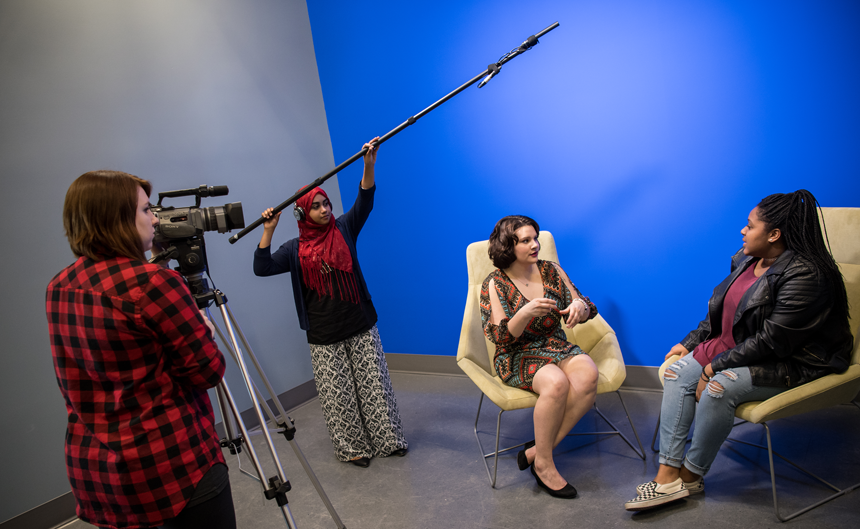
The Communication Arts major offers a chance to study new advances in communications technology, understand principles that remain constant, and respond with appropriate messages for an increasingly dynamic media landscape. Through a liberal arts approach, the curriculum aims to develop effective communication talents in print, visuals, speech, and multimedia.
What to Expect Studying at Notre Dame of Maryland University
Small class sizes allow for personal attention while discussion-based seminars and studio-based production courses offer a well-rounded learning experience. Internships and portfolio development opportunities provide essential career preparation.
Research & Internship Opportunities
A capstone practicum course includes a semester-long professional internship, which greatly increases employability.
Examples of Internships
- The Baltimore Sun
- The Catholic Review
- The Daily Record
- Chase Brexton Health Care
- WYPR Radio
- WIYY 98 Rock
- WJZ TV
Communication Art Careers
- Advertising
- Public Relations
- Digital Design
- Video Production
- Publication Editing
- Social Media Coordination
- Web Content Management
Where do NDMU Graduates Work?
Ou graduates are working in diverse fields for employers such as:
Additional Info
| Fall | Spring | ||
|---|---|---|---|
First Year |
|||
| COM-131 Mass Media and Society | 3 | COM-101 Introduction to Media Writing | 3 |
| Foreign Language | 3 | COM Elective | 3 |
| Natural Science | 4 | Mathematics | 3 |
| ENG-101 College Writing | 3 | RST-201 Introduction to Biblical Studies | 3 |
| NDMU-100 Perspectives in Education | 4 | History or Social Science | 3 |
| [16 credits] | Physical Education | 1 | |
| [16 credits] | |||
Second Year |
|||
| COM-201 Interpersonal and Team Communication | 3 | COM-206 Speaking in Professional Settings | 3 |
| COM-210 Social Media | 3 | COM elective | 3 |
| PHL-201 Introduction to Philosophy | 3 | History or Social Science | 3 |
| English Literature | 3 | PHL or RST 300/400 level | 3 |
| General Education/Course in minor | 3 | General Education/Course in minor | 3 |
| [15 credits] | [15 credits] | ||
Third Year |
|||
| COM-314 Reporting and Writing News | 3 | COM-356 Communication Research Methods | 3 |
| COM Elective | 3 | COM-310 Media Literacy | 3 |
| Course in Minor | 3 | COM-313 Digital Media Skills | 3 |
| Gender Studies/Cross Cultural | 3 | Gender Studies/Cross Cultural | 3 |
| PHL or RST 300/400 level | 3 | Ethics/Values Requirement | 3 |
| [15 credits] | [15 credits] | ||
Fourth Year |
|||
| COM-441 Mass Communication Law | 3 | COM-461 Practicum | 4 |
| COM Elective | 3 | General Education/Minor/Electives | 9-11 |
| General Education/Course in Minor | 6 | [13-15 credits] | |
| Internship | 3 | ||
| [15 credits] | |||
Students accepted into the Dual-Degree Communications program complete at least 90 credits of the BA in three years, and then begin the MA coursework during the fourth year, while simultaneously completing the requirements of the BA. The master’s degree is completed in the fifth year.
Sample 5-Year Plan
| Fall | Spring | ||
|---|---|---|---|
First Year |
|||
| NDMU-100 | 4 | COM-101 | 3 |
| COM-131 | 3 | COM-206 | 3 |
| Gen Ed | 9 | COM Elective 1 | 3 |
| Gen Ed | 6 | ||
Second Year |
|||
| COM-201 | 3 | COM-310 | 3 |
| COM-210 | 3 | COM-313 | 3 |
| COM Elective 2 | 3 | COM-356 | 3 |
| Gen Ed | 6 | Gen Ed | 6 |
Third Year |
|||
| COM-314 | 3 | COM-461 | 3 |
| COM-441 | 3 | COM Elective 3 | 3 |
| Gen Ed | 9 | COM Elective 4 | 3 |
| Gen Ed | 6 | ||
Fourth Year |
|||
| IDS-510 | 3 | CST-515 | 3 |
| COM/CST Elective 1 | 3 | COM/CST Elective 3 | 3 |
| COM/CST Elective 2 | 3 | Grad Elective 1 | 3 |
| Undergrad Electives | 6 | Undergrad Electives | 6 |
Fifth Year |
|||
| COM/CST Elective 4 | 3 | COM/CST Elective 6 | 3 |
| COM/CST Elective 5 | 3 | Grad Elective 3 | 3 |
| Grad Elective 2 | 3 | Grad Elective 4 | 3 |