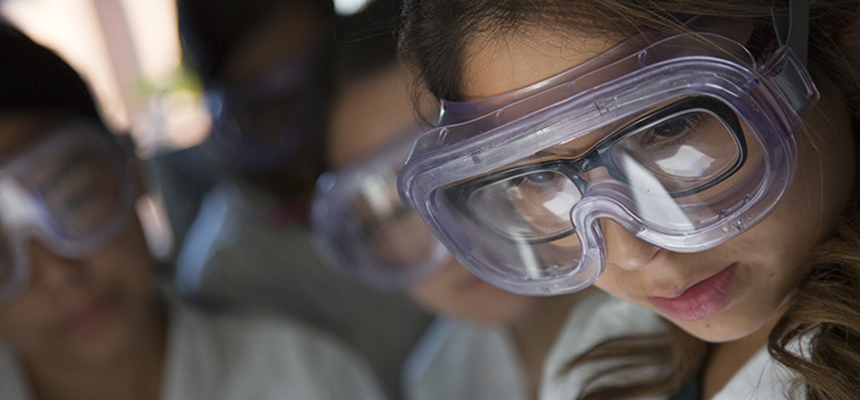
The Biology program offers a broadly based approach to biological systems, ranging from molecular and cellular to ecological and evolutionary biology. It incorporates emerging areas of biology and integrates these with traditional organismal studies. Opportunities for hypothesis-driven experimentation that demands initiative, creativity, and independent research projects are built into the curriculum.
What to Expect Studying at Notre Dame of Maryland University
Small classes, lectures and seminars explore current trends and provide a climate for individualized learning.
Research & Internship Opportunities
As a biology major, you are encouraged to pursue basic or applied research either on-campus or at local universities or research institutions.
Opportunities to present your work include Notre Dame’s annual research symposium in April, Nancy Kreiter Student Research Day, and at local and national meetings featuring undergraduate research. Top students are eligible to join the Sister Alma Science Year fellowship that engages them in hands-on research with scientists at Johns Hopkins School of Medicine.
Note: The Biology Department does not participate in or otherwise facilitate experimentation with live laboratory vertebrates.
Examples of Research Opportunities
- Carnegie Institution of Washington
- The Johns Hopkins School of Medicine
- University of Maryland School of Medicine
- University of Maryland School of Pharmacy
- University of Maryland Shock Trauma Center
- National Institutes of Health (NIH)
- Smithsonian Conservation Biology Institute
- National Museum of Natural History
- National Aquarium in Baltimore
- United States Department of Agriculture
Internships in the biological sciences or in medical or allied health fields are available during the fall, winter, spring and summer semesters.
Biology Careers
We prepare you for employment opportunities in research laboratories, medical and government facilities, pharmaceutical companies and other industries.
Possible Career Opportunities
- Nursing
- Dentistry
- Pharmacy
- Physical Therapy
- Veterinary Medicine
- Pharmaceutical Science
- Biotechnology
- Public Health
- Wildlife Conservation
- Zoos and Aquaria
- Forensic Science
- Food Science
- Marine Biology
- Botany and Plant Science
- Biostatistics
- Biological Engineering
- Bioethics
- Environmental Careers
- Fisheries and Forestry
Additional Info
Below is a sample program of study for the biology major. Many alternatives are possible; please consult a department representative to discuss options.
Students should select courses with the assistance of a faculty adviser and be aware that course cycling will impact upper-level course selection.
| Fall | Spring | ||
|---|---|---|---|
| First Year | |||
| NDMU-100 Perspectives in Education | 4 | BIO-230 Unity and Diversity | 4 |
| BIO-111 Fundamentals of Biology | 4 | CHM-111 General Chemistry II | 4 |
| CHM-110 General Chemistry I | 4 | General Education/Electives | 6-9 |
| General Education/Electives | 3-6 | [14-17 credits] | |
| [14-17 credits] | |||
| Second Year | |||
| BIO-239 Genetics | 4 | One or two 300- or 400-level Biology | 3-8 |
| CHM-210 Organic Chemistry I | 4 | CHM-211 Organic Chemistry II | 4 |
| MAT-211 Calculus I | 4 | MAT-215 Statistics | 4 |
| General Education/Electives | 3-6 | General Education/Electives | 3-6 |
| [15-18 credits] | [14-18 credits] | ||
| Third Year | |||
| One or two 300- or 400-level Biology | 3-8 | One or two 300- or 400-level Biology | 3-8 |
| PHY-101 General Physics I | 4 | PHY-102 General Physics II | 4 |
| General Education/Electives | 3-6 | General Education/Electives | 3-6 |
| [14-18 credits] | [14-18 credits] | ||
| Fourth Year | |||
| One or two 300- or 400-level Biology | 3-8 | One or two 300- or 400-level Biology | 3-8 |
| General Education/Electives | 3-9 | BIO-451 Senior Seminar | 2 |
| [14-18 credits] | General Education/Electives | 3-9 | |
| [14-18 credits] | |||