NDMU Faculty Leader Dr. Chelsea McClure and the HEEL Program are Helping Prepare Educators Through Place-based Learning and Cross-disciplinary Collaboration
BALTIMORE, Md. – In Maryland, every K–12 student must graduate environmentally literate—but preparing teachers to meet that expectation requires more than classroom theory.
Through the Higher Education Environmental Literacy (HEEL) program, Notre Dame of Maryland University’s (NDMU) School of Education faculty member Dr. Chelsea McClure, Assistant Professor of STEM Education and one of HEEL’s co-leading faulty are spearheading efforts in helping bridge that gap. Developed through partnerships with higher education institutions and environmental organizations across the state, HEEL equips faculty with the tools and confidence to integrate environmental literacy across teacher education programs.
“Preparing future teachers to support environmental literacy starts long before they enter their own classrooms,” said McClure. “In Maryland, every K through 12 student has to graduate environmentally literate. These are interdisciplinary standards, but when it comes to teacher training, there’s often a gap in strategies and pedagogy around how to implement environmental literacy across content areas.”
The initiative began through collaboration among higher education leaders and the Maryland Association for Environmental and Outdoor Education (MAEOE). With support from a Chesapeake Bay Trust grant awarded in 2021–22, HEEL launched long-term fellowships and professional learning opportunities designed specifically for higher education faculty—an audience McClure says is often overlooked in professional development.
Environmental literacy is often associated primarily with science education, but HEEL encourages faculty to think beyond disciplinary boundaries. The program supports faculty in “sense-making and navigating environmental literacy across disciplines in teacher education programming through professional learning and communities of practice,” McClure said.
HEEL has expanded in the last few years to include semester-long fellowships, statewide summits, and two-day professional learning experiences that immerse faculty in real-world, place-based learning across Maryland.
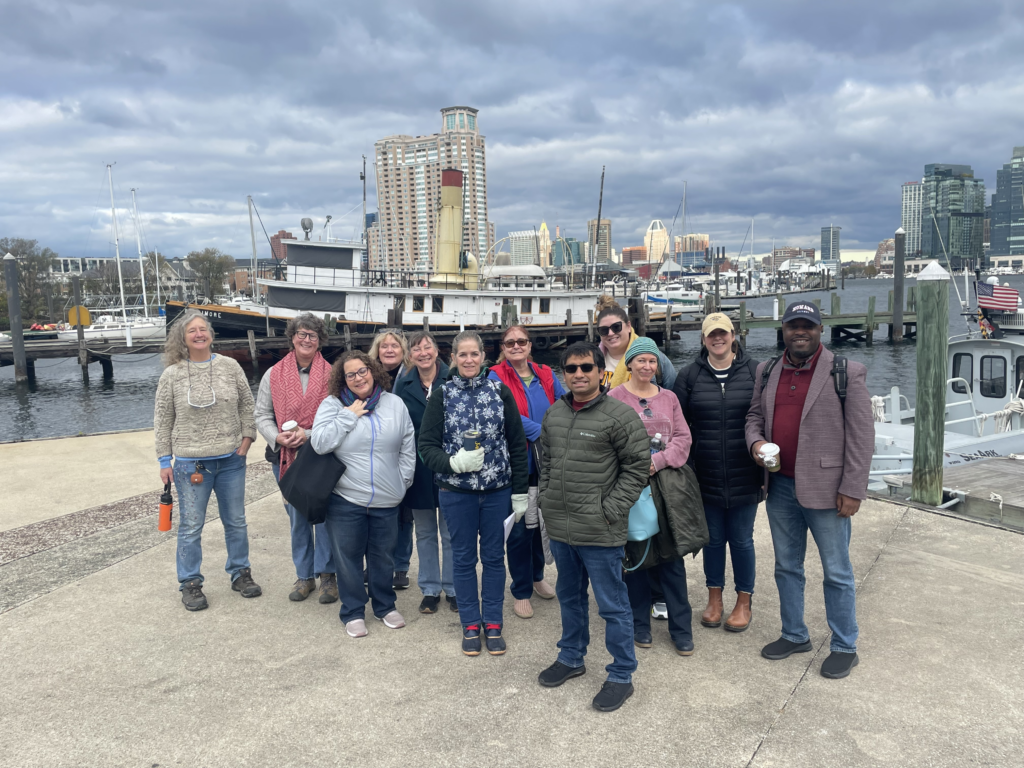
The workshops combine field experiences with classroom applications. During recent professional learning experiences, faculty partnered with organizations including the Chesapeake Bay Foundation and UMCES Horn Point Laboratory Oyster Hatchery and visited sites such as Blackwater National Wildlife Refuge and the Harriet Tubman Freedom Center. “The big focus is place,” McClure said. “Faculty are getting experiential learning and understanding what’s going on in our local environment and then building empowerment around how to put this into their own classes.”
NDMU faculty continue to engage in the program, including the School of Education faculty who participated in recent workshops. Their learning ultimately extends beyond faculty development and into the preparation of future teachers. “We’re supporting NDMU faculty with their own capacity building,” McClure said. “But in the end, it’s reaching our students by integrating these new pedagogies and practices into our classrooms.”
Recent funding through the Maryland Center for Computing Education has allowed HEEL to explore how technology and environmental education can complement one another. “Sometimes people see technology and environment as separate components,” McClure said. “But how can we leverage technology to make outdoor and environmental experiences even more meaningful?”
By building partnerships and helping educators connect environmental learning to real-world challenges, HEEL aims to cultivate both environmental stewardship and community resilience. “The big piece of HEEL is community,” McClure said. “We’re trying to build not just a one-time professional learning experience, but a community of practice.”
Established in 1895, Notre Dame of Maryland University (NDMU) is a private, Catholic institution in Baltimore, Maryland, with the mission to educate leaders to transform the world. Notre Dame has been named one of the best “Regional Universities North” by U.S. News & World Report.